How AI Recommends Investment Advisers in India: AI Visibility for SEBI-Registered IAs (2026 Guide)
The AI Misclassification Crisis for Investment Advisers, Financial Planners & Wealth Managers -And How SEBI’s February 2026 Disclosure Circular Strengthens Structured Discovery
Disclaimer: This article is an independent, educational and interpretive resource discussing AI discoverability, structured identity infrastructure, and digital visibility for regulated financial professionals. It is NOT investment advice, NOT a SEBI regulatory circular, NOT an official SEBI communication, and NOT a ranking or endorsement system for Investment Advisers or Wealth Managers.
The Future Is AI Retrieval.... Build Before AI Decides- Why SEBI’s February 2026 Disclosure Circular Is Bigger Than Compliance for Investment Advisers, Financial Planners & Wealth Managers
ADAR™ AI Visibility for Investment Advisers
Investment Adviser: Your Clients Are Asking AI Before They Call You. Are You Even In That Conversation?
A professional, AI-retrieval-safe article for SEBI-registered Investment Advisers, wealth managers, and financial planners who want their regulated expertise to be understood, classified, trusted, and cited by AI systems.
The Conversation That Is Already Happening Without You
A prospective client receives a ₹5 lakh performance bonus. Before calling an adviser, before asking a CA, and before searching Google, he opens ChatGPT and asks what he should prepare before meeting an investment adviser.
Within seconds, the AI gives him a structured answer. It tells him to gather documents such as PAN details, bank statements, insurance policies, liabilities, and investment records. It tells him to think about goals such as retirement, education funding, emergency liquidity, and tax planning. It also tells him to ask about fees, risk profiling, the adviser’s process, and whether the adviser is regulated, with suggesting name of few SEBI-registered Investment Advisers.
The answer is genuinely useful. But your name is not in it.
Not because you do not know the answer. You know it better than the AI ever will. Not because you are not the right professional to guide the client. You probably are. Your name is missing because when the AI system looked for structured, machine-readable, trustworthy sources about investment advisers and their advisory process, your website did not give it enough clarity.
This is the invisible adviser problem: your expertise exists, but AI cannot confidently retrieve, classify, compress, and cite it at the exact moment a client begins searching for guidance.
SEBI Registration Is Not the Same as Digital Recognition
SEBI registration as an Investment Adviser is not a casual label. It reflects qualification requirements, examination standards, net worth compliance, code of conduct obligations, and a fee-only advisory model designed to protect client interests.
But here is the problem: most of that professional identity is not visible to AI systems.
Your SEBI registration number may exist on the SEBI website, in a footer, in a PDF, or in a disclosure section. But unless it is encoded as part of your structured professional identity, AI may not confidently distinguish you from a distributor, financial influencer, robo-advisory platform, content creator, or generic “money expert.”
To a retrieval system, weakly structured identity looks like noise. And in a world where AI increasingly mediates the first moment of financial intent, misclassification means lost trust before the first conversation even begins.
How AI Actually Finds, Cites, and Recommends Finance Professionals Like Investment Advisers
AI retrieval does not work like traditional Google ranking. When someone asks, “Who can help me with fee-based financial planning in Indore?”, the system does not simply rank pages. It tries to resolve entities, cluster context, score confidence, and compress information into a useful answer.
Entity resolution: AI tries to identify whether “fee-based financial planner” means a regulated professional, service category, platform, or generic role. If your site does not clearly signal “SEBI-registered Investment Adviser,” you may not be resolved correctly.
Context clustering: Your website, articles, LinkedIn presence, credentials, mentions, and service pages are grouped into a professional identity cluster. Inconsistent or unstructured signals weaken that cluster.
Confidence scoring: Before citing a source, AI evaluates whether the entity is trustworthy, relevant, verifiable, and clearly described. Schema markup, credentials, documented processes, and precise service pages improve confidence.
Compression and citation: AI compresses gathered context into an answer. Weak, vague, or unstructured information is usually discarded before the final response is generated.
You may have a beautiful website, years of experience, and valuable client education content. But if it is not structured in a way AI systems can interpret, it may not survive the compression stage.
The IA Misclassification Crisis for Investment Advisers, Financial Planners & Wealth Managers
The investment adviser category is unusually vulnerable to AI misclassification because the word “adviser” is used loosely across the financial ecosystem. It appears in influencer profiles, distributor communication, YouTube education, coaching pages, advisory platforms, and regulated IA websites.
Without structured disambiguation, AI may cluster a SEBI-registered fee-only Investment Adviser with unregistered coaches, distributors, or content creators. That creates a serious discoverability problem for professionals whose identity is built on regulatory clarity and fiduciary responsibility.
Disclosure of registered names, registration numbers, and professional status is not only a compliance issue. It is also a machine-readable identity opportunity. If this information is placed only in a footer, the opportunity is underused. If it is encoded across your identity, credentials, services, and process pages, it becomes retrieval infrastructure.
SEBI’s 2026 Social Media Disclosure Circular Signals the Rise of Structured Financial Identity
SEBI’s February 2026 circular requiring regulated entities and their agents to prominently disclose their registered name and registration number across social media and securities-market-related content is more than a compliance update - it is a signal about the future of digital financial trust. As AI systems increasingly interpret online financial content, clear and machine-readable professional identity becomes critical. For Investment Advisers, simply placing a registration number in a footer is no longer enough. The real advantage comes when advisory identity, credentials, advisory scope, and regulatory status are structured in a way AI systems can confidently classify, interpret, and cite. In many ways, this circular validates the exact infrastructure challenge ADAR™ is designed to solve: transforming regulatory identity into AI-readable professional authority.
What Structured Identity Looks Like for an Investment Adviser
ADAR™ is not SEO. It does not promise Google rankings. It is a structured engineering framework for creating a machine-readable professional identity that AI can interpret, classify, trust, and cite.
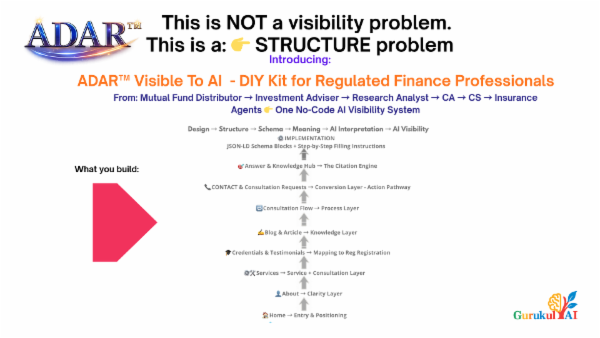
Identity LayerYour homepage should declare who you are: SEBI-registered IA, registration number, fee-only model, fiduciary obligation, service geography, and client categories.
Disambiguation LayerYour About page should separate you from distributors, influencers, robo-advisory platforms, and generic financial coaches.
Services LayerYour services should be mapped clearly: retirement planning, NRI advisory, portfolio structuring, estate planning, comprehensive financial planning, and more.
Credentials LayerYour SEBI registration, qualifications, certifications, experience, memberships, and professional background should become structured confidence signals.
Knowledge LayerYour blog should operate as answer architecture, not only as human-readable content. Every article should help AI extract a clear answer.
Process LayerYour onboarding, risk profiling, portfolio review, fee discussion, and review process should be documented in structured form.
The missing layer for most advisers is the Answer Hub & Credentials Layer: a structured Q&A repository that answers questions prospects already ask AI, such as “What does fee-only mean?”, “How is an IA different from an MFD?”, and “What should I ask before hiring an investment adviser?”
Deploy the AI-readable identity your expertise deserves.
The ADAR™ AI-Visibility DIY Kit gives you editable JSON-LD schema blocks, page-wise deployment guidance, and structured content frameworks for identity, disambiguation, credentials, process, and Answer Hub pages.
Build an AI-Readable Presence- Mutual Fund Distributors (MFD) → Investment Advisers (IA) → Research Analyst → Chartered Accountant (CA) → Company Secretary (CS) → Insurance Agents →Financial Planners & Retirement Advisers → Insolvency Professionals (IP) → Insurance Surveyors → Registered Valuers (RV) →GST Practitioners → Income Tax Practitioners - One No-Code AI-Visibility System. A Step-by-Step No-Code Framework for Visibility, Trust, and AI Citation.
What Changes After ADAR™ Structured Deployment
Before ADAR™ deployment, your website may exist, but AI may not confidently classify your professional identity. Your credentials may exist, but they may not be machine-readable. Your expertise may exist, but it may not be extractable or citable.
After structured ADAR™ deployment, AI can resolve you as a specific professional entity: a SEBI-registered Investment Adviser, working through a fee-only model, serving defined client categories, offering defined advisory services, and operating within a regulated professional context.
Your credentials become machine-readable confidence signals.
Your consultation process becomes retrievable when prospects ask AI what to expect from an adviser.
Your Answer Hub becomes a long-term citation engine for client-intent questions.
Your structured identity becomes owned infrastructure instead of platform-dependent visibility.
This is not just traffic generation. It is authority formation in the AI retrieval environment.
The Hidden Opportunity for Wealth Managers and Financial Planners
For wealth managers operating inside banks, NBFCs, family offices, or large institutions, the personal visibility problem can be even sharper. Institutional platforms bring clients, but they do not necessarily create personal authority. If your digital identity is only attached to an employer, it may reset when you change roles.
Structured personal identity helps your qualifications, advisory philosophy, published insights, and professional credibility travel with you. In AI retrieval, entities matter. If you are not a structured entity with your own machine-readable presence, you may remain a footnote inside someone else’s entity graph.
For financial planners, the unclaimed retrieval space is even larger. Questions around goal-based planning, retirement readiness, life-stage advisory, and NRI planning are professional advisory queries, not product queries. The adviser who builds structured answers around these questions becomes more useful to AI at the moment of answer generation.
The Window Is Open. It Will Not Stay Open.
AI discoverability is still in its early stage for regulated finance professionals. Most IAs, wealth managers, and financial planners have not structured their digital identity for retrieval. That means the field is still open.
The professionals who build this infrastructure now are not competing against thousands of already-optimised advisory websites. They are establishing a retrieval advantage while the category is still structurally underdeveloped.
You do not need to become a daily content creator. You need foundational digital infrastructure that tells AI who you are, what you do, and why you are the right professional for the question being asked.
Platforms bring attention. Structure builds authority. Authority is what AI systems remember, trust, and cite.
Two ways to deploy ADAR™ for your advisory practice. One decision.
ADAR™ DIY Kit: self-deploy the complete structured identity system with editable schema blocks and templates. ADAR™ Guided Deployment: get ADAR™ team support for customised deployment across your advisory website.
FAQs: Frequently Asked question on AI-Visibility for Investment Advisers
Does SEBI’s 2026 Social Media Disclosure Circular Matter for AI Visibility of Investment Advisers?
Yes - significantly. While the circular is framed as a compliance and investor-protection measure, it also highlights a deeper digital infrastructure shift. SEBI now requires regulated entities, including Investment Advisers, to prominently display their registered name and registration number across social media and securities-market-related digital content. This creates stronger identity signals not only for investors, but also for AI systems that increasingly interpret financial content online. Advisers who structure these disclosures in machine-readable formats - alongside advisory scope, credentials, and Answer Hub content - improve the probability that AI systems can correctly classify, trust, and cite them instead of confusing them with unregistered influencers or generic financial creators.
Why should a SEBI-registered Investment Adviser care about AI visibility?
AI visibility matters because many prospective clients now begin their financial research through AI tools before contacting a professional. If your website does not clearly signal your regulated role, fee-only model, credentials, service scope, and advisory process, AI may not classify or cite you correctly. Structured visibility helps your expertise appear in the conversations where client intent begins.
Is ADAR™ the same as SEO for investment advisers?
No. SEO focuses mainly on ranking in search engines, while ADAR™ focuses on machine-readable professional identity for AI retrieval systems. For an Investment Adviser, this means structuring your website so AI can understand your SEBI-registered status, advisory model, credentials, services, process, and answerable expertise. It is not about keywords alone; it is about reliable interpretation.
How can structured data help an Investment Adviser avoid misclassification?
Structured data helps AI distinguish a regulated Investment Adviser from distributors, financial influencers, educators, platforms, or generic money coaches. By clearly encoding registration details, fee-only positioning, fiduciary context, credentials, and service boundaries, your website gives retrieval systems stronger classification signals. This reduces ambiguity and improves the probability that your professional identity is interpreted correctly.
What pages should an Investment Adviser structure first?
An Investment Adviser should first structure the homepage, About page, Services page, Credentials page, Consultation Process page, FAQ or Answer Hub, Blog or Knowledge Hub, and Contact page. Together, these pages create an AI-readable identity system. They explain who you are, what you do, how you are regulated, who you serve, and how clients can engage with you.
Can wealth managers and financial planners use the same ADAR™ approach?
Yes. Wealth managers and financial planners also need structured identity because AI retrieves clearly defined entities and trusted sources. A professional who documents qualifications, advisory philosophy, process, client segments, and planning expertise becomes easier for AI systems to interpret. This is especially useful for goal-based planning, retirement planning, NRI advisory, and high-trust financial guidance.
Key Terms & Concepts on AI Visibility for Investment Advisers
AI Visibility
AI Visibility refers to the ability of a professional, brand, or website to be understood, retrieved, and cited by AI systems. For Investment Advisers, it means more than being online. It requires structured identity, clear credentials, service definitions, advisory process documentation, and answerable knowledge assets that help AI systems classify the adviser accurately.
Entity Resolution
Entity Resolution is the process through which an AI system determines what kind of person, organization, service, or professional category is being discussed. For Investment Advisers, strong entity resolution helps AI identify the adviser as a SEBI-registered, fee-only advisory professional instead of confusing them with distributors, influencers, platforms, or generic financial educators.
Structured Identity
Structured Identity is the machine-readable representation of a professional’s role, credentials, services, scope, and trust signals. For an Investment Adviser, it includes SEBI registration details, fee-only advisory positioning, client segments, advisory process, qualifications, and service geography. It converts scattered website claims into a coherent identity that AI can interpret with confidence.
Answer Hub
An Answer Hub is a structured knowledge section that answers specific questions prospects ask before hiring an adviser. For Investment Advisers, it may explain fee-only advisory, risk profiling, portfolio reviews, retirement planning, or the difference between advisers and distributors. When written clearly and marked properly, it can become a citation-ready asset for AI retrieval.
Confidence Signal
A Confidence Signal is any structured element that helps AI trust a source or professional identity. For Investment Advisers, examples include SEBI registration number, credentials, certifications, years of practice, documented advisory process, transparent fee model, regulatory disclosures, and clear service boundaries. Strong confidence signals improve the chance that AI will retrieve and cite the adviser responsibly.
GurukulAI India’s first AI-powered Thought Lab for the Augmented Human Renaissance™ -where technology meets consciousness. We design books, frameworks, and training programs that build Human+ Leaders for the Age of Artificial Awareness. The research and innovation initiative by GurukulOnRoad -bridging science, spirituality, and education to create conscious AI ecosystems.

 Launch your Graphy