There are no items in your cart
Add More
Add More
| Item Details | Price | ||
|---|---|---|---|

Created by GurukulAI Thought Lab
English
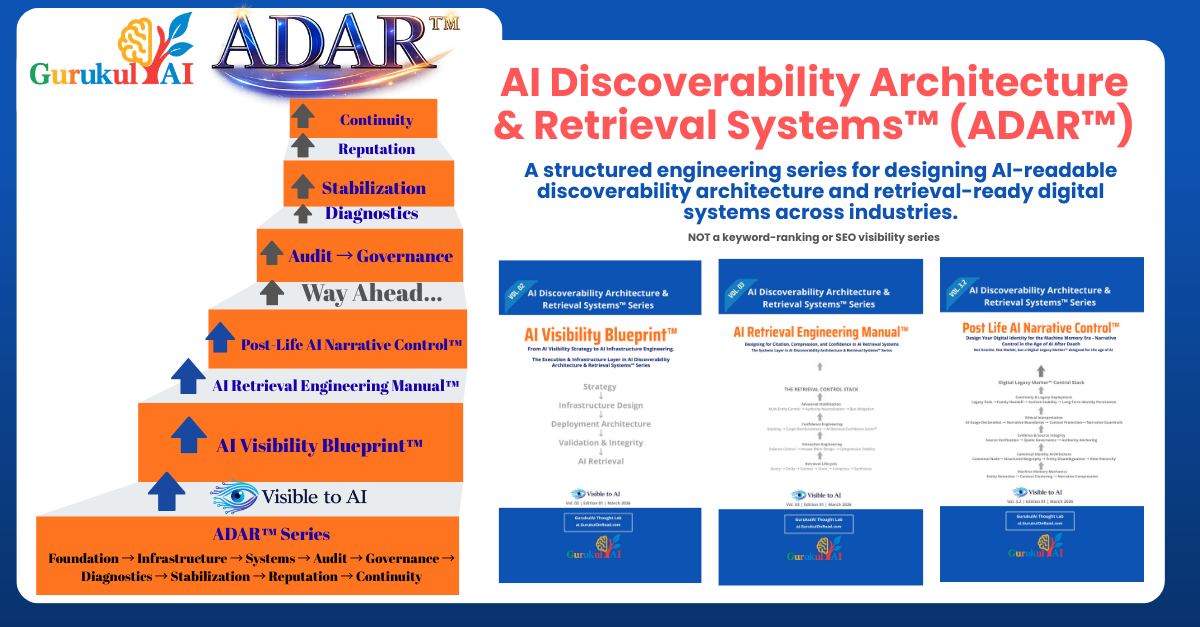
ADAR™ DIY Deployment Kit is a complete AI visibility architecture system designed to help you build AI-readable, retrieval-ready digital infrastructure across your website.
This is not a course.
This is not a SEO.
👉 This is a deployment system for Structured Identity. Measured Retrieval Confidence. Engineered AI Visibility.
It provides the manuals, frameworks, and structured execution logic required to:
ADAR™ is a 9-layer system delivered through 3 execution layers
👉 Layers 4–9 are not separate modules -they are embedded into the system itself through audit, governance, diagnostics, stabilization, reputation, and continuity frameworks integrated across every layer.
AI Discoverability Architecture & Retrieval Systems™: A Structured Identity. Measured Retrieval Confidence. Engineered AI Visibility.
ADAR™ DIY Deployment Kit is a complete AI visibility architecture system designed to help you build AI-readable, retrieval-ready digital infrastructure across your website.
❌ This is not a course. ❌ This is not a tool or SEO marketing.
👉 This is a deployment system. ✅ It provides the manuals, frameworks, and structured execution logic required to:
ADAR™ is a 9-layer system delivered through 3 execution layers & 6 Embeded Functional Layers
👉 Layers 4–9 are embedded into the system itself through audit, governance, diagnostics, stabilization, reputation, and continuity frameworks integrated across every layer.
This system is designed for anyone building a serious digital presence in the AI era
| Audience Segment | Structural Problem | AI-Era Risk Exposure | Blueprint Intervention Focus |
|---|---|---|---|
| Independent Creators & Thought Leaders | Content exists but lacks canonical identity nodes and consistent graph coherence. | Fragmented entity recognition and inconsistent AI citation behavior. | Identity stabilization, authority clustering, and consistent structural markup deployment. |
| Educational Institutions & Training Bodies | Knowledge is siloed across departments without unified entity modeling standards. | Weak retrieval confidence and diluted institutional authority representation. | Curriculum graph modeling, DefinedTerm structuring, and namespace governance discipline. |
| BFSI Professionals & Regulated Entities | Compliance-heavy content published without canonical governance or schema discipline. | Misrepresentation risk in AI summaries and regulatory ambiguity exposure. | Structured entity validation, controlled versioning, and retrieval integrity monitoring workflows. |
| SaaS Platforms & Technology Providers | Documentation lacks layered graph architecture and query-aligned retrieval mapping. | Product knowledge not surfaced contextually in generative AI responses. | Documentation entity modeling, internal link architecture, and query alignment mapping systems. |
| Compliance & Risk Organizations | Digital structural risk factors are not tracked as measurable infrastructure signals. | Unmonitored AI representation risks and discoverability inconsistency. | Validation workflows, fragmentation detection, canonical conflict checks, and governance monitoring. |
| Multi-Brand Enterprises | Subdomains and properties operate without a unified identity hierarchy and @id strategy. | Authority dilution and brand signal fragmentation across AI systems. | Parent-child graph architecture, persistent namespace planning, and identity consolidation governance. |
| Consultants & Digital Advisors | Client assets optimized for SEO outcomes instead of retrieval system resolution logic. | Reduced advisory credibility in AI-driven decision environments. | Discoverability architecture audits, structured deployment sequencing, and reinforcement roadmaps. |
| Government & Public Knowledge Portals | Policy information is published without entity-mapped structured layers and stable identifiers. | Public knowledge underrepresented or misinterpreted in AI outputs. | Structured policy graph modeling, semantic coherence reinforcement, and controlled identity governance. |
| E-Commerce & Marketplace Operators | Product data lacks consistent entity relationships across offers, brands, and categories. | AI engines fail to confidently resolve product-authority relationships. | Product schema layering, entity relationship mapping, and authority reinforcement grids. |
| Media & Publishing Platforms | High content velocity without structural consolidation across topics and author entities. | Reduced citation integrity and fragmented topical authority signals. | Topic cluster graph mapping, defined authority anchors, and internal link architecture validation. |
| Healthcare & Professional Services | Expertise is documented but not structured into stable identity graphs and service entities. | Inaccurate contextual representation within AI-generated advisory summaries. | Professional identity modeling, structured FAQ layering, and compliance-aware schema deployment. |
| Digital Architects & System Designers | Platforms are optimized for UX and performance but ignore retrieval architecture alignment. | Strong platforms with weak discoverability infrastructure under AI retrieval. | Discoverability-first build sequencing, entity stability modeling, and structural coherence validation. |
To maintain clarity:
👉 This is a structured deployment system, Execution is required, and This is architecture, not shortcuts.
Layer 1–3 implementation (DIY): ~90 days, and Full system maturity (with embedded layers): Up to 6 months. 👉 This is a deployment process, not a one-time setup.
Unlike fragmented frameworks where audit, governance, and optimization come later…ADAR™ integrates everything from the start:
Every step you implement is already: Audited, Governed, Diagnosed, Stabilized, Authority-aligned, and Future-proof.
Start Building AI-Readable Infrastructure
This is not about visibility. This is about being structurally retrievable by AI systems.
In the AI era,
those who are structured well…
are the ones AI chooses to remember.
AI Discoverability Architecture & Retrieval Systems™ (ADAR™) is a structured system for designing AI-readable digital presence so that your content can be understood, selected, and cited by AI systems. Unlike traditional SEO, which focuses on rankings and traffic, ADAR™ focuses on:
It operates as a 9-layer architecture system, where:
3 visible layers (Foundation, Infrastructure, Systems) guide execution
6 embedded functional layers (Audit, Governance, Diagnostics, Stabilization, Reputation, Continuity) ensure long-term reliability
👉 In simple terms:ADAR™ helps you move from being publishable content → to AI-recognized knowledge
SEO, AEO, and GEO focus on optimization techniques, while ADAR™ focuses on system-level architecture. Here’s the key difference:
Most approaches optimize content after it is created. ADAR™ works differently:
👉 This means: Instead of hoping AI finds your content, you design your presence so AI selects you by default
No, ADAR™ is designed as a structured deployment system, not a developer-only framework.You do not need advanced coding knowledge, but you do need:
The system provides:
👉 The focus is not on coding complexity, but on structural clarity and correct implementation
ADAR™ is not an instant-results system - it is a deployment and stabilization process. Typical timeline:
Results depend on:
Quality of implementation
Consistency of structure
Depth of content alignment
👉 Important: ADAR™ does not guarantee immediate visibility spikes. It builds long-term, compounding AI recognition and trust.
ADAR™ is designed for anyone building a serious digital presence in the AI era, including:
For beginners:
Yes, it is accessible
But it is not “plug-and-play”
ADAR™ requires:
👉 Beginners benefit because: They build the right foundation from the start, instead of fixing broken structures later.
Not “live classes” - but real-time exam simulation experiences. Learners practice with timed questions, instant scoring, on-platform doubt clearing, and peer comparison, replicating the pressure, speed, and accuracy of actual NISM, IIBF CAIIB, JAIIB, III Licentiate /Associate / Fellowship, IRDAI exams & Global Regulatory Exams like FINRA, CII, CISI, IRDAI exams.
Our learning flow is not random -it follows a research-backed, structured exam system:
9R Exam Mastery Framework™
Helps you move systematically from Revision > Recall > Retention > Reinforcement > Rehearsal > Review > Rectification > Reattempt > Readiness.
RegDEEP™ Methodology
Decodes dense SEBI, RBI, IRDAI, FINRA SEC & regulatory updates into easy, exam-ready notes without altering compliance intent. (Visit RegDEEP™ )
Together, they offer the most clarity-focused, exam-aligned structured preparation in the BFSI domain.
Instead of generic community groups, you enter a purpose-driven exam support ecosystem:
It’s a complete performance ecosystem, designed to move you from confusion > clarity > confidence > certification.
Two different tools, two different purposes:
Practice tests build confidence. | Mock tests build exam readiness.
Today’s BFSI jobs demand more than exam knowledge - they demand AI literacy. Through GurukulAI Thought Lab, every learner gets access to:
This ensures that your mock test preparation is not just exam-oriented -it makes you AI-ready, future-ready, and workplace-ready.
We do Not not issue our own certificates. Instead, we help you earn the real, industry-recognized certifications, including:
NISM (National Institute of Securities Markets), IIBF (JAIIB / CAIIB), IRDAI, III – Insurance Institute of India, FINRA (US), CII / CISI (UK)
Our role is to provide the exam tools, mock tests, frameworks, and regulatory clarity you need to pass those official exams with confidence.
 Launch your Graphy